



Apple Mac mini M6 vs. AMD Ryzen AI 9 HX 470: Is It Worth Switching?
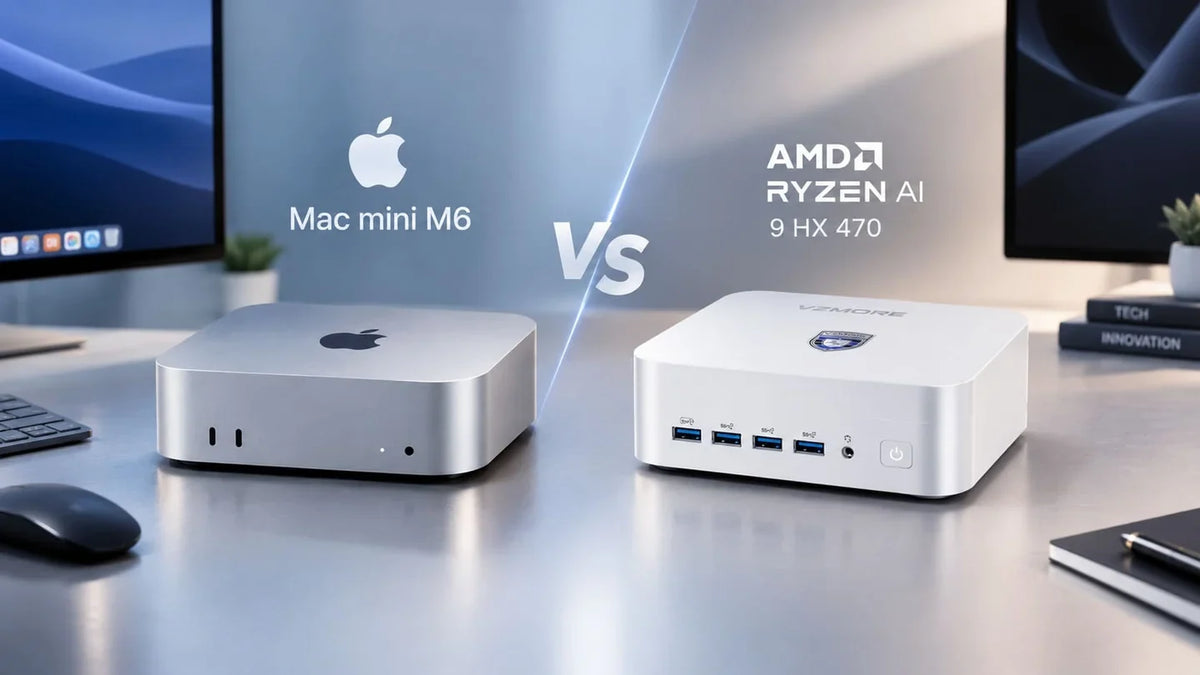
New chip architectures always cause a stir in the tech world. With Apple unveiling its latest Mac mini generation on 25 August 2026, attention has turned once again to the contest between Apple’s in-house silicon and AMD’s powerful x86 alternatives. Apple has set the release date for 22 September 2026, and independent hands-on testing is still to come. For everyday users, creatives and business users, that leaves one key question: does the new generation deliver enough performance for demanding day-to-day tasks, or is a more flexible x86 platform based on the AMD Ryzen AI 9 HX 470 the more cost-effective, future-proof choice?
Key Takeaways
• Different chip philosophies: The Apple M6 is built on a highly integrated SoC architecture with unified memory, while the AMD Ryzen AI 9 HX 470 focuses on versatility, strong multithreaded performance and modularity.
• A focus on AI: Both platforms have dedicated NPUs for AI workloads. AMD’s 55 TOPS provide a strong foundation for running AI models locally, while Apple relies on a Dual Neural Engine.
• Memory and expandability: Apple’s memory is integrated into the chip package and can’t be upgraded. The Ryzen AI 9 HX 470 supports flexible DDR5 SO-DIMM configurations and multiple M.2 SSDs.
• Connectivity and infrastructure: Apple relies heavily on Thunderbolt, while modern Ryzen systems offer a wider choice of ports, including dual 2.5G Ethernet and native video outputs.
• Verification status: M6 performance figures are currently based on Apple’s own claims from August 2026, whereas the AMD platform is already proven in real-world use and thoroughly validated.
What Is the Apple M6? An Overview of the New Mac mini Chip
On 25 August 2026, Apple unveiled the latest evolution of its chip architecture (MacRumors, 25 Aug 2026). The Apple M6 is built on an advanced 2-nanometre process and has 12 CPU cores and 12 GPU cores (9to5Mac, 25 Aug 2026). A major new feature is the dual Neural Engine, made up of two separate 16-core blocks, which promises a significant boost in machine learning performance.
A defining feature of the architecture remains unified memory. The CPU, GPU and Neural Engine all access the same physical memory pool directly, without detours via internal buses, enabling extremely low latency. Apple quotes the M6’s memory bandwidth at up to 170 GB/s and says this allows seamless performance in graphics-intensive applications. As industry observers noted at launch, “Apple’s new M6 sets new standards, particularly in how it integrates memory and accelerators.” However, as shipping doesn’t begin until 22 September 2026, these benchmark promises have yet to be independently verified in real-world use.
What Is the AMD Ryzen™ AI 9 HX 470? The Chip Inside the VZMORE AX9 Max
On the other side is the AMD Ryzen™ AI 9 HX 470, one of the most powerful silicon designs for compact systems. Based on the latest Zen 5 architecture, the chip combines 12 physical CPU cores with 24 threads, making it ideal for heavy multitasking, complex calculations and virtualisation. Graphics are handled by the integrated AMD Radeon™ 890M, which is built on the RDNA 3.5 architecture and can take on demanding rendering and visualisation tasks without a dedicated graphics card.
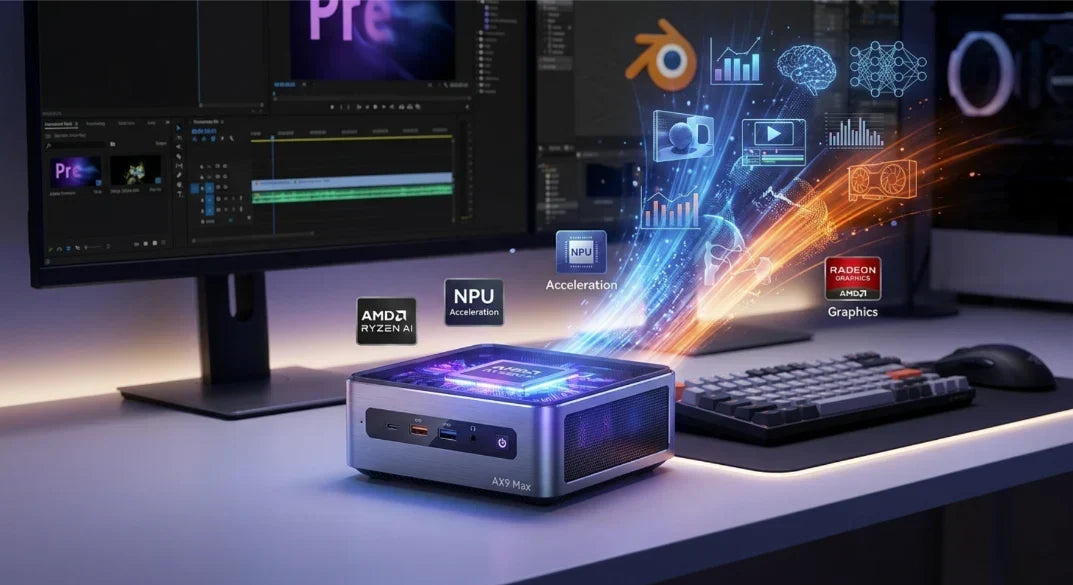
A key focus of the Ryzen AI 9 HX 470 is hardware acceleration for artificial intelligence. Its upgraded Neural Processing Unit (NPU) delivers up to 55 TOPS (trillion operations per second), so the processor easily meets the strict requirements of modern Copilot+ applications and local large language models (LLMs). The processor is also highly flexible when it comes to power consumption: depending on the cooling system and performance profile, its thermal design power (TDP) can be set to 45, 54 or 65 watts. This high-performance processor is at the heart of the AX9 Max AI Mini PC, where it can deliver its full potential.
How Do the Apple M6 and AMD Ryzen AI 9 HX 470 Compare on Paper?
A side-by-side look at the specifications highlights the fundamentally different design philosophies of the two chipmakers. Apple is all about maximum integration and proprietary manufacturing, while the AMD platform offers the highest level of compatibility and system flexibility.
|
Specification |
Apple M6 (Mac mini M6) |
AMD Ryzen AI 9 HX 470 (e.g. AX9 Max) |
|
CPU cores / threads |
12 cores / 12 threads |
12 cores / 24 threads |
|
Graphics (GPU) |
12-core integrated GPU |
AMD Radeon™ 890M (RDNA 3.5) |
|
NPU performance (AI) |
Dual Neural Engine (2× 16-core) |
55 TOPS (XDNA 2 architecture) |
|
Manufacturing process |
2 nm |
4 nm |
|
Memory bandwidth |
Up to 170 GB/s |
Platform-dependent (dual-channel DDR5) |
|
Maximum RAM |
Up to 32 GB unified memory (soldered) |
Up to 256 GB DDR5 SO-DIMM (tested up to 64 GB) |
|
Storage options |
Proprietary SSD (not upgradeable) |
2× M.2 PCIe 4.0 NVMe slots (up to 4 TB + 1 TB) |
|
Configurable TDP |
Fixed (not disclosed) |
45 W / 54 W / 65 W (adjustable) |
Read also: Mac mini M5 Pro vs. Ryzen AI 9 HX 470: Performance, AI and Expandability Compared
Which Chip Is Faster: The M6 or the Ryzen AI 9 HX 470?
When it comes to speed, transparency is essential. Apple and AMD each use their own testing methods, which can’t simply be compared like for like. On top of that, all information on the Mac mini M6 currently comes solely from Apple’s announcement on 25 August 2026 (9to5Mac, 25 Aug 2026), as retail units won’t ship until late September 2026. A blanket verdict would therefore not be credible.
Everyday CPU Performance: Multitasking and Office Work
For everyday office work, browsing with lots of tabs open and light word processing, both processors have performance to spare. The Apple M6 benefits from high single-core clock speeds and extremely fast access to unified memory, which pays off in app launch times and short command sequences. The AMD Ryzen AI 9 HX 470, on the other hand, comes into its own in genuinely multithreaded scenarios. With 24 threads running in parallel, compute-heavy background tasks such as data compression, database queries or virtual machines can run at the same time without the user interface stuttering.
Graphics Performance: Apple GPU vs. Radeon 890M
The Apple M6’s 12-core GPU is tuned for Metal-optimised software on macOS, such as Final Cut Pro and DaVinci Resolve. Thanks to shared memory, the GPU can in theory use the full 32 GB of RAM as texture memory. The AMD Radeon™ 890M in the Ryzen AI 9 HX 470, meanwhile, sets the benchmark for integrated x86 graphics. It offers excellent encoding and decoding for modern video codecs (AV1, HEVC) and supports open standards such as Vulkan and DirectX 12 Ultimate. For visual workflows on Windows or Linux, it’s a reliable and extremely capable GPU.
How Much AI Performance Do the Two Chips’ NPUs Deliver?
Apple and AMD are both investing heavily in AI accelerators. With the M6, Apple is using a Dual Neural Engine with two 16-core blocks for the first time, handling tasks such as image segmentation, speech recognition and text generation directly on the chip in macOS. AMD equips the Ryzen AI 9 HX 470 with an XDNA 2 NPU rated at exactly 55 TOPS. This defined level of performance guarantees full compatibility with local AI frameworks such as Microsoft Copilot+ and ONNX Runtime. While Apple’s official press release from August 2026 didn’t break down TOPS figures using standardised industry benchmarks, AMD’s fixed 55 TOPS rating allows developers to plan local AI workloads precisely.
How Does Your Choice of Chip Affect Memory and Storage?
One of the most significant differences between the two platforms is how flexible their memory architecture is. In the Mac mini M6, Apple places the RAM directly on the chip package. This enables enormous bandwidth of up to 170 GB/s, but it comes with a major drawback: the configuration is final at the point of purchase. Memory is capped at 32 GB of unified memory and can’t be upgraded or repaired later.
Systems based on the AMD Ryzen AI 9 HX 470 take a much more user-friendly approach. The platform supports standard DDR5-5600 SO-DIMM memory in dual-channel mode. The processor specification allows for up to 256 GB of RAM, and internal testing confirms flawless operation with up to 64 GB. The x86 platform also wins on storage: with Apple, the only ways to expand are pricey build-to-order upgrades or external Thunderbolt drives, whereas motherboards such as the one in the VZMORE AX9 Max offer two M.2 NVMe PCIe 4.0 slots. You can easily add SSDs of up to 4 TB in the primary slot and 1 TB in the secondary slot.
What Ports Do the Two Platforms Offer?
Your choice of chip has a major impact on the I/O available. Apple typically equips the Mac mini M6 with three Thunderbolt 4 ports. These deliver fast transfer speeds for compatible peripherals, but in a typical office you’ll often need adapters or a docking station for older monitors, Ethernet cables or SD cards.
The AMD Ryzen AI 9 HX 470 platform is designed from the ground up for maximum connectivity in the workplace. Typical mini PC implementations offer a wide variety of ports, with no additional dock required:
• 2× USB4 ports: Full-featured ports with up to 40 Gbps of bandwidth for displays, external GPUs or high-speed SSDs.
• 2× HDMI 2.1: Native video outputs for multi-monitor set-ups at resolutions of up to 8K at 60 Hz.
• 2× 2.5G Ethernet (RJ45): Dual multi-gigabit network ports for high-speed wired networking, NAS connections or load balancing.
• 1× SD 4.0 card reader: Fast, direct photo and video imports for content creators.
• Multiple USB-A ports: Native connections for keyboards, mice, printers and other traditional peripherals.
How Do the Two Platforms Handle Cooling and Sustained Workloads?
High performance requires well-designed thermal management to avoid thermal throttling under sustained load. Apple hasn’t yet published detailed acoustic or cooling data for the new Mac mini M6. How the 2 nm design will behave in its compact case during long rendering sessions remains an open question until the first independent reviews after its release on 22 September 2026.
Advanced Ryzen systems, by contrast, already rely on proven cooling technology. To keep the Ryzen AI 9 HX 470 running stably at its higher power levels (54 W/65 W), leading manufacturers use vapour chamber cooling. This slim evaporative system spreads the CPU’s heat across a large area to the cooling fins. The result is highly efficient heat dissipation that keeps noise levels extremely low, even under full load. If you’re looking for a powerful desktop replacement, you’ll benefit from a proven, quiet system design. With cooling designs like these, our mini PCs strike the ideal balance between a compact form factor and sustained peak performance.
Which Chip Is Right for Which Use Case?
Choosing between the Apple M6 and the AMD Ryzen AI 9 HX 470 comes down mainly to your requirements in terms of software ecosystem, expandability and networking.
The Apple M6 is a good fit for:
• Users who are fully committed to the Apple ecosystem and make use of seamless integration with their iPhone or iPad.
• Users of specialist macOS software such as Final Cut Pro or Logic Pro.
• Projects where maximum single-core performance in an ultra-compact form factor is the top priority.
The AMD Ryzen AI 9 HX 470 is a good fit for:
• Professionals who need a native Windows or Linux environment for productive workflows.
• Power users who value being able to upgrade RAM (up to 256 GB) and NVMe storage (up to 5 TB in total) later on.
• Networking specialists and homelab enthusiasts who benefit from two fast 2.5G Ethernet ports.
• Buyers looking for excellent value for money, such as the VZMORE AX9 Max with its generous bundle and modern ports.
Frequently Asked Questions
Is the Apple M6 faster than the AMD Ryzen AI 9 HX 470?
A direct comparison isn’t clear-cut, owing to the different operating systems (macOS vs. Windows/Linux) and differing benchmark methods. While the M6 is likely to shine in single-core tasks, the Ryzen AI 9 HX 470’s 24 threads give it the edge in multithreaded applications and heavy multitasking.
How comparable are TOPS figures between Apple and AMD?
TOPS (trillion operations per second) measures the raw number of operations an NPU can perform each second. AMD rates its XDNA 2 NPU at exactly 55 TOPS. Apple uses a Dual Neural Engine design in the M6 but doesn’t publish directly comparable, standard TOPS figures. In practice, real-world AI performance depends heavily on how well the software is optimised.
Which chip is better for multitasking?
With its Zen 5 architecture, 12 physical cores and 24 threads, the AMD Ryzen AI 9 HX 470 is exceptionally well suited to running processes in parallel. Combined with flexibly upgradeable DDR5 memory, it easily handles memory-intensive scenarios with many applications running at once.
Can I install Windows on a Mac mini?
Windows can no longer be installed natively on Apple silicon chips such as the M6. Windows applications can only be run in virtual machines (such as Parallels Desktop), which may come at a cost to performance. If you rely on native Windows software, you’re far better off with an x86 platform such as the Ryzen AI 9 HX 470.
Conclusion: Is It Worth Switching?
There’s no simple yes or no when comparing the Apple M6 and the AMD Ryzen AI 9 HX 470. The two architectures serve different audiences. If you’re already deeply invested in macOS and want a closed, compact system, the Mac mini M6 is a capable step forward, but you should be aware of its limitations when it comes to upgradeability and ports.
For users who value maximum flexibility, straightforward RAM and SSD upgrades and an extensive range of ports, the AMD Ryzen AI 9 HX 470 is the more versatile platform. With strong NPU performance, excellent multithreaded performance and native Windows compatibility, this chip architecture offers a highly attractive all-round package for the modern workplace.

VZMORE is a leading manufacturer of AI Mini PCs. Our systems combine whisper-quiet VC cooling, high performance, and intelligent AI processing power—tailored for demanding applications in home offices, creative workflows, and edge computing. Enjoy free shipping on all orders.
Related Articles

Subscribe to Newsletter
Get the latest news, product updates, and exclusive offers delivered straight to your inbox.