



Vapour Chamber vs. Heat Pipe: Which Cooling Is Better for Mini PCs?
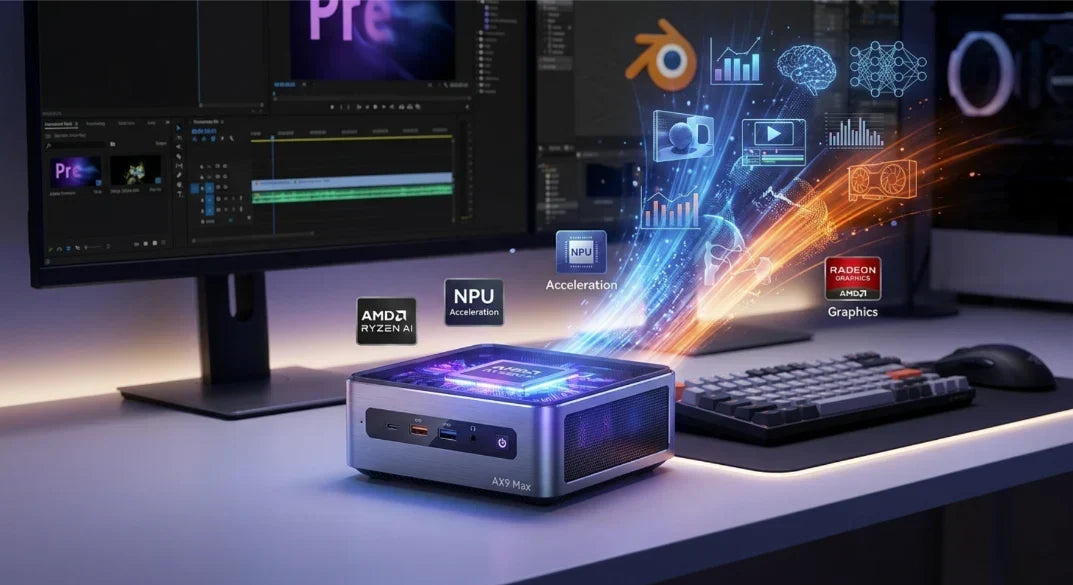
Compact mini PCs pack maximum computing power into minimal space. But the high power density of the latest processors poses enormous challenges for thermal management. Reliable heat dissipation largely determines whether a system can deliver its full performance continuously without throttling, or whether it overheats under load. At the heart of this technical comparison are traditional heat pipes and advanced vapour chambers. But which cooling technology offers the better characteristics for modern compact systems under real-world conditions?
Key Takeaways
• Heat pipes, the tried-and-tested standard: Heat pipes rely on one-dimensional (linear) heat dissipation. They are a cost-effective, highly efficient cooling method, ideally suited to moderate workloads and affordably priced mini PCs.
• Vapour chambers for hotspots: Vapour chambers spread heat in two dimensions (across a surface). This lets them distribute localised heat from high-performance processors much faster and prevents thermal throttling under sustained peak loads.
• Form factor and space savings: The flat design of a vapour chamber frees up valuable space inside the case. This allows for even more compact designs or room for additional hardware components.
• Manufacturing effort and cost: Elaborate manufacturing processes and the integration of complex wick structures make vapour chambers more expensive to produce than conventional copper heat pipes.
• The use case decides: For everyday applications, office work and media playback, conventional heat pipes are entirely sufficient. For graphics-intensive tasks, sustained full load, AI workloads or maximum noise reduction, a vapour chamber offers clear advantages.
How Does a Heat Pipe Work? The Classic Cooling Principle Explained
The heat pipe has been the backbone of computer cooling for decades. Its physical principle is based on a closed phase-change cycle inside a sealed copper tube. Inside the pipe is a small amount of working fluid (usually demineralised water) under vacuum, along with a porous inner lining known as the capillary or wick structure.
When heat from the processor reaches the evaporator section of the heat pipe, the working fluid evaporates even at low temperatures, because the internal pressure is extremely low. Driven by the pressure difference, the resulting vapour travels at lightning speed to the cooler end of the pipe (the condenser), which is connected directly to the fan’s cooling fins. There, the vapour releases its thermal energy, condenses back into liquid and is carried back to the evaporator by the capillary action of the wick. This continuous phase change enables extremely fast heat transfer, many times greater than the thermal conductivity of solid copper alone. According to the Fraunhofer Institute for Physical Measurement Techniques IPM, a heat pipe transfers 100 to 1,000 times more heat than a solid body of the same dimensions, making it a more effective heat conductor than any other known material.
How Does a Vapour Chamber Work?
A vapour chamber is based on the same thermodynamic principle as a heat pipe: a cycle of evaporation and condensation. The crucial design difference, however, lies in its geometry. Whereas a heat pipe transports heat mainly in one dimension along a single axis, a vapour chamber works as a flat, two-dimensional hollow system.
Instead of a cylindrical tube, a vapour chamber consists of a flat, sealed metal enclosure with a complex internal microstructure. Its underside is in direct contact with the heat source (e.g. the CPU or GPU). As soon as the working fluid evaporates at the thermal hotspot, the vapour immediately spreads out in every horizontal direction (360 degrees) throughout the entire cavity. On the large upper surface of the chamber, the fluid condenses over a wide area and releases the heat evenly to the attached heatsinks. The condensed fluid then flows back evenly via the wick structure in the walls. A simple analogy is a hot hob: pour water into a narrow tube and only one strip cools down; pour it onto a flat tray and the cooling effect spreads across the entire surface instantly.
Vapour Chamber vs. Heat Pipe: A Head-to-Head Comparison
The choice of cooling design has a direct impact on the thermal efficiency, case layout and overall cost of a compact computer. The table below compares the key specifications and physical characteristics of both technologies:
|
Criterion |
Heat pipe |
Vapour chamber |
|
Heat spreading |
1D (linear, along the pipe) |
2D (across a surface, in all directions) |
|
Typical thermal conductivity |
approx. 10,000–50,000 W/m·K (effective) |
approx. 20,000–100,000 W/m·K (effective, across the surface) |
|
Hotspot efficiency |
Standard; localised heat can build up |
Very high; eliminates localised hotspots instantly |
|
Height & form factor |
Cylindrical (usually 6–8 mm diameter), requires a bend radius |
Extremely flat (often 2–4 mm), can be shaped to fit a surface |
|
Manufacturing costs |
Low to moderate (highly standardised mass production) |
High (complex sealing and wick structures) |
|
Space required in the case |
Needs room for pipe routing and bend radii |
Compact, as it sits flat on the board |
Why Are More and More Manufacturers Switching to Vapour Chamber Cooling?
The trend towards ever more compact designs, combined with rising power consumption, is forcing hardware engineers to rethink cooling structures. While heat pipes reach their physical limits when they require many bends and space is tight, the two-dimensional spreading of a vapour chamber provides significantly better thermal coverage of modern processors.
A look at neighbouring technology sectors shows that this principle is not only finding its way into high-performance laptops and ultra-compact PCs, but is increasingly transforming the entire consumer electronics market. Teardowns of the latest smartphones, such as the report on iFixit’s iPhone 17 Pro teardown on MacRumors, show that vapour chambers are increasingly being used even in extremely densely packed mobile devices to sustain peak performance without overheating. The teardown report explicitly states that “a vapor chamber cooling system” provides the necessary stability under sustained load. This development highlights an industry-wide shift: wherever heat needs to be dissipated in the tightest of spaces, the vapour chamber is becoming the gold standard.
Noise emissions also play a major role. When a cooling system moves heat from the chip to the cooling fins more quickly, the fans can run at lower speeds. If you’d like to know how thermal bottlenecks and fan control are connected, find out more in our article “Why Is My Mini PC So Loud?”.
How VZMORE Puts Vapour Chamber Cooling into Practice
The practical benefits of advanced cooling technology are particularly evident in highly integrated computer architectures. To ensure maximum performance with minimal noise, VZMORE relies on carefully engineered thermal designs across its models. Its V-Cooling technology seamlessly combines the physical advantages of a vapour chamber with the design of the case.
Our mini PCs use this two-dimensional cooling system to absorb the heat from modern multi-core processors across a large area and dissipate it immediately. The vapour chamber is supported by an optimised 360° air intake and vertical airflow. This targeted chimney effect ensures that the heat released by the vapour chamber is expelled directly from the case without building up. The result is consistently stable operation, even under demanding workloads, combined with pleasantly quiet running.
Pros and Cons of Both Systems
Advantages of heat pipes
• Cost-efficiency: Proven mass production keeps the price of cooling solutions low.
• Flexible routing: Individual heat pipes can be routed flexibly around components to heatsinks located further away.
• Reliability: A robust design without complex sealed enclosures ensures an exceptionally long service life.
Advantages of vapour chambers
• Superior heat dissipation: Faster heat transfer thanks to two-dimensional spreading directly at the hotspot.
• Space-saving height: A very slim profile allows for slimmer mini PC cases or more room for RAM and SSD slots.
• Even temperature distribution: Prevents localised heat build-up on the processor die and reduces stress on the silicon.
• Quieter operation: Higher cooling efficiency means the fans can run at lower speeds.
Limitations and drawbacks of both systems
Conventional heat pipes quickly reach their limits with modern high-end processors that have a high transistor density, because the small cross-section of the pipe can’t return liquid quickly enough when heat is concentrated in one spot. The result is localised overheating (a hotspot) and a drop in CPU clock speed (thermal throttling).
The main drawback of a vapour chamber, on the other hand, is its significantly higher manufacturing cost. Precision-manufacturing the flat vacuum chambers and integrating the internal capillary microstructures require complex production steps. In addition, a vapour chamber has a rigid shape and cannot be bent afterwards, which makes adapting it to different case layouts more challenging during the design process.
Which Type of Cooling Suits Which Use Case?
Which cooling principle is the best choice for your mini PC depends primarily on how you use it:
• Office work, web browsing and media playback (a heat pipe is sufficient): If you mainly use your mini PC for spreadsheets, video calls, browsing the web or 4K streaming, a conventional heat pipe system is perfectly adequate. Heat output stays moderate, and heat pipe cooling offers unbeatable value for money.
• Demanding workloads, gaming and AI applications (a vapour chamber is preferable): If you regularly edit videos, render in 3D or work with complex data analysis, or if you use your mini PC for gaming and local AI models, a vapour chamber is well worth the investment. It ensures that the processor maintains its maximum boost clock even after hours of full load, without the system throttling or the fans becoming distractingly loud.
FAQs
Is a vapour chamber always better than a heat pipe?
In thermodynamic terms, a vapour chamber offers clear performance advantages when it comes to spreading heat across a surface. That said, it isn’t essential in every case. For systems with low power consumption (TDP) or with heatsinks positioned far apart, well-sized heat pipes can be just as effective while also costing less.
Why is vapour chamber cooling more expensive to manufacture?
A vapour chamber consists of two precisely formed half-shells that must be hermetically welded together in a vacuum under high pressure and specific conditions. On top of that, adding the internal wick structure (usually sintered copper powder or fine mesh) is technically far more demanding than filling a simple copper tube.
Do all high-end devices use vapour chamber cooling these days?
Its market share is growing steadily. While the technology used to be found mainly in servers and high-end graphics cards, it is now increasingly used in compact premium laptops, powerful mini PCs and even modern flagship smartphones to dissipate heat from maximum performance in the smallest of spaces.
How can I tell which type of cooling a mini PC uses?
Manufacturers usually state the type of cooling in the technical data sheet or on the product page (e.g. terms such as “vapour chamber” or proprietary technology names such as “V-Cooling”). A quick look at official product descriptions or expert reviews will usually tell you.
Conclusion
Both heat pipes and vapour chambers have their place in the mini PC market. While the classic heat pipe remains a reliable, cost-effective solution for everyday computing tasks, vapour chamber cooling is the superior technology for power-hungry compact systems. Its two-dimensional heat dissipation protects against thermal throttling and allows for quiet operation even under heavy load. If you’re looking for maximum performance in a compact form factor, a vapour chamber solution is the future-proof choice.

VZMORE is a leading manufacturer of AI Mini PCs. Our systems combine whisper-quiet VC cooling, high performance, and intelligent AI processing power—tailored for demanding applications in home offices, creative workflows, and edge computing. Enjoy free shipping on all orders.
Related Articles

Subscribe to Newsletter
Get the latest news, product updates, and exclusive offers delivered straight to your inbox.