



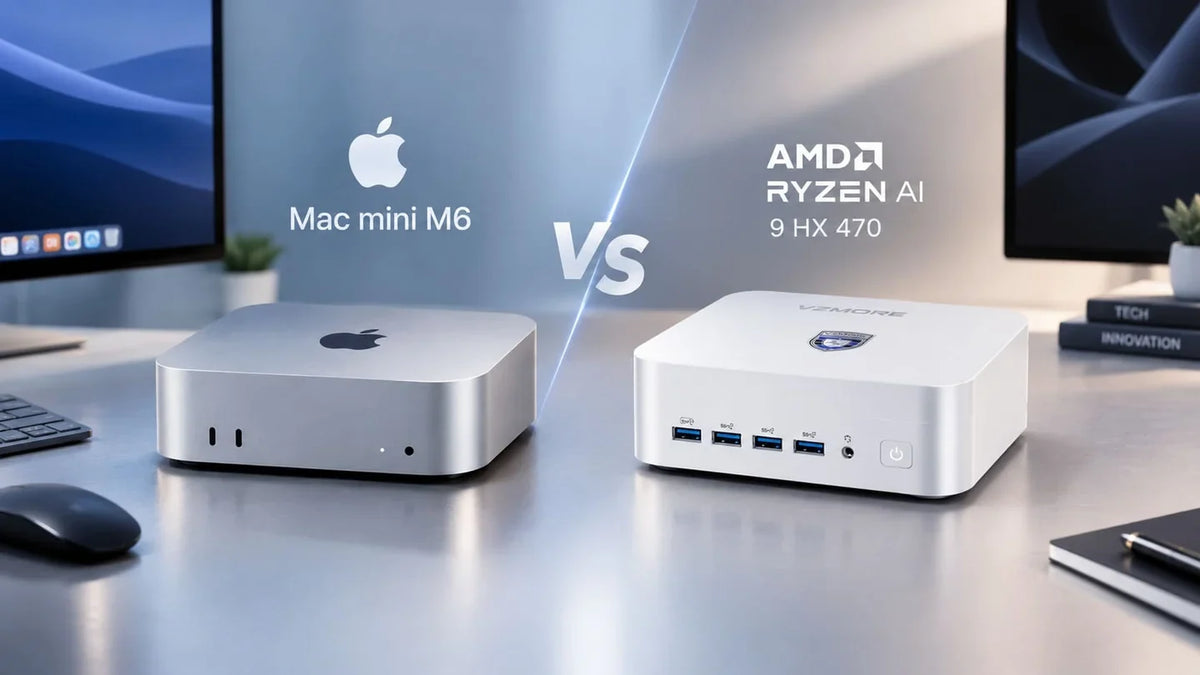
Mac mini M5 Pro vs. Ryzen AI 9 HX 470: Performance, AI and Expandability Compared

Key Takeaways
• Apple announced the Mac mini with M5 Pro on 25 August 2026, with shipping from 22 September. No independent benchmark results were available at the time of writing.
• What we do know are the manufacturer’s specifications. The M5 Pro has 15 or 18 CPU cores and 16 or 20 GPU cores, delivers 307 GB/s of memory bandwidth and supports up to 64 GB of unified memory.
• The AMD Ryzen AI 9 HX 470 offers 12 cores and 24 threads, a Radeon 890M and an AI engine rated at 55 TOPS. In the AX9 Max, it can run at 45, 54 or 65 watts.
• A like-for-like comparison of AI performance remains open, as Apple no longer publishes a TOPS figure for the M5 generation.
• Apple fixes RAM and SSD at the factory, while the AMD platform uses swappable DDR5 SO-DIMM modules and two freely configurable M.2 slots.
• On connectivity, Apple leads with three Thunderbolt 5 ports, while the AMD platform counters with two 2.5 Gigabit Ethernet ports and six USB-A ports.
What Is the Apple M5 Pro? An Overview of the New Pro Chip
The M5 Pro is the professional variant of the current Apple silicon generation and powers the new Mac mini alongside the smaller M6. Apple unveiled both chips on 25 August 2026, with shipping from 22 September 2026.
Technically, the M5 Pro comes in two configurations. The base version pairs 15 CPU cores with 16 GPU cores, while the larger version offers “up to an 18-core CPU paired with up to a 20-core GPU”, as 9to5Mac summarises Apple’s specifications. These are joined by a 16-core Neural Engine, 307 GB/s of memory bandwidth and up to 64 GB of unified memory. Unified memory refers to a shared memory pool that the CPU, GPU and AI accelerators can all access without copying data back and forth.
The biggest change is the graphics architecture. Each GPU core has its own Neural Accelerators and third-generation ray tracing units. SSD options range from 512 GB to 8 TB, and the base configuration starts with 24 GB of memory. In the UK, the Mac mini with M5 Pro starts at £1,699 (as of September 2026).
What Is the AMD Ryzen™ AI 9 HX 470 in a Pro Configuration?
The Ryzen AI 9 HX 470 is based on the Zen 5 architecture and features 12 cores and 24 threads with a boost clock of up to 5.1 GHz. AMD combines four full-size Zen 5 cores with eight more compact, efficiency-focused Zen 5c cores. The integrated Radeon 890M uses the RDNA 3.5 architecture, with 16 compute units and dedicated ray tracing cores.
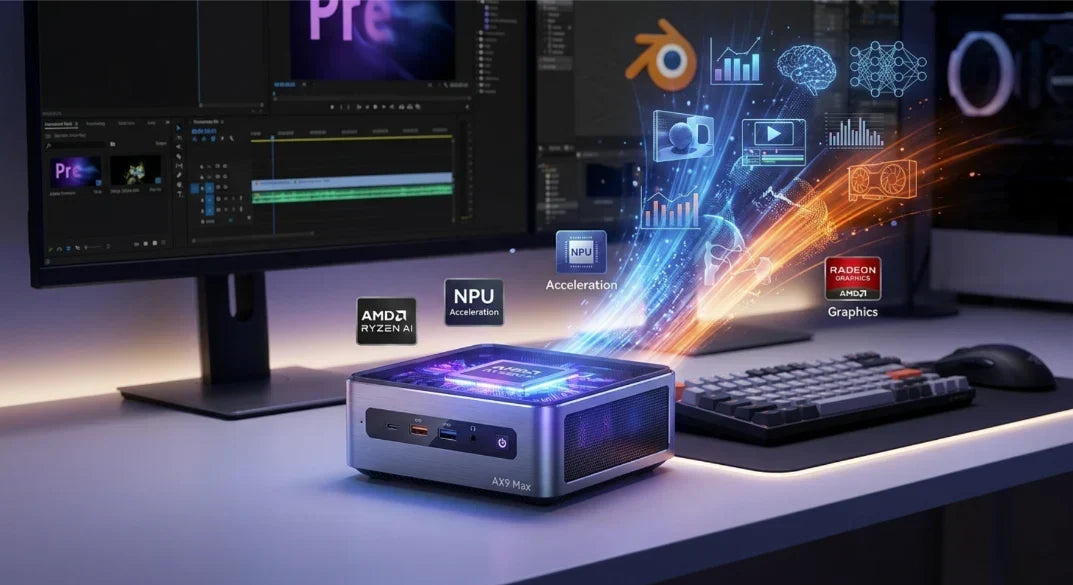
For AI tasks, the chip has a dedicated NPU that delivers 55 TOPS. TOPS stands for trillions of operations per second and describes the theoretical peak performance of an AI engine. Combined with the CPU and GPU, VZMORE rates the platform at 86 TOPS.
How the chip performs in a desktop depends heavily on the power envelope the case allows. VZMORE’s AX9 Max runs the processor in three performance modes: 45 watts in Silent mode, 54 watts in Balanced mode and 65 watts in Performance mode. It comes with 32 GB of DDR5 RAM, a 1 TB SSD and Windows 11 Pro as standard, and is priced at £1,349. All figures for the AMD platform below refer to this configuration in 65-watt mode.
How Do the Apple M5 Pro and AMD Ryzen AI 9 HX 470 Compare on Paper?
The table below compares the two spec sheets side by side. Apple’s figures come from coverage of the announcement on 25 August 2026; AMD’s figures come from the AX9 Max specifications.
|
Feature |
Apple M5 Pro (Mac mini) |
AMD Ryzen AI 9 HX 470 (AX9 Max) |
|
CPU cores |
15 cores (base), up to 18 cores |
12 cores, 24 threads, up to 5.1 GHz |
|
Graphics |
16 GPU cores (base), up to 20 cores, 3rd-gen ray tracing |
Radeon 890M, RDNA 3.5, 16 compute units, ray tracing cores |
|
AI engine |
16-core Neural Engine plus Neural Accelerators in each GPU core, no TOPS figure |
NPU with 55 TOPS, 86 TOPS for the whole system |
|
Memory bandwidth |
307 GB/s |
Dual-channel DDR5, no manufacturer figure |
|
RAM |
Up to 64 GB unified memory, fixed at purchase |
Swappable DDR5 SO-DIMM, rated up to 256 GB (tested with 64 GB) |
|
Storage |
512 GB to 8 TB SSD, fixed at purchase |
M.2 2280 up to 4 TB plus a free M.2 2230 slot up to 1 TB |
|
High-speed ports |
3× Thunderbolt 5, 2× USB-C (USB 3) |
2× USB4 (40 Gbps), 6× USB-A |
|
Display outputs |
3× Thunderbolt 5, 1× HDMI, up to three 6K displays |
2× HDMI 2.1, plus USB4 |
|
Networking |
2.5 Gb Ethernet, optional 10 Gb, Wi-Fi 7, Bluetooth 6 |
2× 2.5 Gb Ethernet, Wi-Fi 7, Bluetooth 5.4 |
|
Cooling |
Not specified by the manufacturer |
Vapour chamber with fan, 38 dB |
|
Operating system |
macOS |
Windows 11 Pro |
|
Starting price |
£1,699 (24 GB, 512 GB SSD) |
£1,349 (32 GB, 1 TB SSD) |
Read also: Apple Mac mini M6 vs. AMD Ryzen AI 9 HX 470: Is It Worth Switching?
Which Chip Is More Powerful for Professional Workloads?
A reliable answer isn’t possible yet. Only manufacturer specifications are available for the M5 Pro, and independent testing is still pending. The editors at Macworld note that their own benchmarks will follow once they receive review units. Anyone buying today should be aware of this gap.
There’s also a methodological problem. Each manufacturer benchmarks against its own previous generations: Apple against earlier M-series chips, AMD against Windows benchmarks. These figures can’t be converted into one another, as they’re based on different operating systems, compilers and test scenarios.
AI Acceleration: How Comparable Are the Neural Engine and the NPU, Really?
Both platforms include specialised processing units for AI tasks. Apple calls its unit the Neural Engine, while in the Windows world the term NPU, short for Neural Processing Unit, has become the norm. Their job is the same in both cases: running models for image recognition, speech recognition or text processing locally, rather than sending data to the cloud.
The comparison falls down because of the data available. AMD rates the HX 470’s NPU at 55 TOPS. With the M5 generation, Apple stopped publishing TOPS figures and instead highlights the Neural Accelerators in its GPU cores, which means part of the AI workload shifts to the GPU. Without a comparable metric for both sides, any head-to-head comparison would be misleading.
The Windows context offers a practical point of reference. Microsoft requires an NPU with more than 40 TOPS for Copilot+ features. At 55 TOPS, the Ryzen AI 9 HX 470 exceeds that threshold and meets the requirements for on-device AI features in Windows. macOS has no equivalent threshold; there, Apple’s own software support is what counts.
Computing Performance for Video, 3D and Development Workloads
When it comes to raw computing power, the architecture speaks for itself. In its larger configuration, the M5 Pro has 18 CPU cores, more than the HX 470’s 12. Even more significant is its 307 GB/s of memory bandwidth. In 4K or 8K video editing, 3D rendering and compiling large codebases, speed often depends less on the number of cores than on how quickly data moves between the processing units and memory.
The AMD platform makes its case on capacity. Its dual-channel design with DDR5 SO-DIMM modules can’t match the bandwidth of a unified memory system, but it supports far larger amounts of memory. For running several virtual machines or keeping large datasets in memory, that’s the more important lever.
How Much RAM and Storage Do Professional Workloads Really Need?
For Premiere, Adobe recommends 16 GB of RAM for HD footage and 32 GB or more for 4K and higher resolutions (as of 21 January 2026). With lots of effect layers, several applications open at once or long timelines, real-world requirements are often higher. The entry-level Mac mini with M5 Pro and 24 GB of unified memory handles HD and basic 4K work, while more demanding projects call for larger configurations.
The key difference is when you have to decide. With the Mac mini, you choose your RAM and SSD at the point of purchase, and neither can be upgraded later. Underestimate your capacity needs and you’re looking at buying a new machine. The AMD platform uses socketed DDR5 SO-DIMM modules, rated up to 256 GB and internally tested with up to 64 GB, plus two M.2 slots for 4 TB and 1 TB.
In practice, that means you can start with a moderate configuration and upgrade as your project workload grows. This saves money, as memory modules and SSDs are cheaper on the open market than factory upgrades. For specific configurations, see the overview of VZMORE mini PC models.
What Ports Do the Platforms Offer for Professional Set-Ups?
When it comes to connectivity, the verdict is mixed. Apple fits three Thunderbolt 5 ports. Thunderbolt 5 transfers 80 Gbps in both directions and can switch to up to 120 Gbps in one direction for demanding displays. For external RAID systems, fast video editing storage and set-ups with up to three 6K displays, that’s a genuine advantage the AMD platform doesn’t offer in this form.
The AX9 Max provides two 40 Gbps USB4 ports, plus six USB-A ports, two HDMI 2.1 outputs, an SD card reader and a headphone jack. Its strength is breadth: older peripherals and multiple displays can be connected without adapters.
One point deserves particular attention. The AMD platform has two 2.5 Gigabit Ethernet ports; the Mac mini has one. For homelab builds, virtualisation or separating a management network from a data network, that second port is a structural advantage that’s hard to replicate with an adapter. Apple offers 10 Gigabit Ethernet as a paid upgrade, but still via a single port.
How Do Both Platforms Behave Under Sustained Load?
There are no independent measurements of the new Mac mini’s thermal behaviour yet. Apple hasn’t disclosed the cooling design of the M5 Pro model, and without review units it’s impossible to say whether the chip can sustain its peak performance or throttles after extended periods at full load. Until the first reviews appear, this remains an unknown.
The AMD side is better documented, as the platform is already on the market. In the AX9 Max, VZMORE uses a vapour chamber with a regulated fan. A vapour chamber is a flat, liquid-filled chamber that spreads heat over a large area through evaporation, rather than carrying it away through individual heat pipes. The manufacturer quotes a 40 per cent larger heat-spreading area, 50 per cent higher transfer efficiency and a noise level of 38 dB.
What matters in practice is the combination of cooling and performance modes. If you run compute-heavy workloads all the time, choose the 65-watt mode; for quiet working environments, the 45-watt mode lowers the fan speed. The Mac mini doesn’t offer this choice, as the system manages it on its own. For details of the cooling design, see the technology overview on the VZMORE website.
Which Chip Is the Better Choice for Which Professional Use Case?
For video production with high-resolution footage, for 3D rendering and for workflows firmly rooted in macOS, there’s a strong case for the M5 Pro. Its memory bandwidth, Thunderbolt 5 connectivity and support for three 6K displays address exactly these needs.
The sums look different for Windows-based work. Development environments with virtual machines, data analysis with heavy memory requirements, homelab builds and local AI applications benefit more from the AMD platform. For these, the AX9 Max delivers expandable memory, two Ethernet ports and an NPU above the Copilot+ threshold.
Budget matters too. The Mac mini with M5 Pro starts at £1,699 with 24 GB of memory and a 512 GB SSD; the AX9 Max starts at £1,349 with 32 GB and 1 TB. When comparing similarly specified configurations, the price gap is even wider than at entry level.
Frequently Asked Questions (FAQ)
Is the Apple M5 Pro better for AI workloads than the AMD Ryzen AI 9 HX 470?
That can’t be proven at this stage. Apple doesn’t publish a TOPS figure for the M5 generation, while AMD specifies 55 TOPS. Without a comparable metric and without independent benchmarks, any claim of superiority is speculation. In practice, software matters more anyway: on Windows, Copilot+ support is the deciding factor; on macOS, it’s Apple’s own applications.
How much RAM do you need for professional video editing?
For Premiere, Adobe specifies 16 GB for HD footage and 32 GB or more for 4K and higher resolutions. In practice, that’s the bare minimum. Once you add effect layers, colour grading and other applications, 64 GB is a realistic target.
What’s the difference between the AMD Ryzen AI 9 HX 470’s NPU and the Apple M5 Pro’s Neural Engine?
Both are specialised processing units for AI models, but they differ in design. AMD relies on a dedicated NPU with a stated 55 TOPS. Apple combines a 16-core Neural Engine with Neural Accelerators in every GPU core and doesn’t publish a TOPS figure. As a result, more of the workload is handled by the GPU.
Which chip is better suited to homelab and networking set-ups?
The AMD platform has the edge here. Two 2.5 Gigabit Ethernet ports allow for separate networks, router or firewall use, and redundant connections without extra hardware. Add to that the expandable memory, which is the limiting factor when running several virtual machines. The Mac mini has one Ethernet port, with an optional 10 Gigabit upgrade.
Conclusion: Which Chip Is the Better Choice for Professionals?
This comparison ends without a clear winner, and based on the information available today, that’s the most honest answer. The Apple M5 Pro stands out with 307 GB/s of memory bandwidth and three Thunderbolt 5 ports, which are hard to replace for professional video and display set-ups. That advantage is real and shouldn’t be played down.
The AMD Ryzen AI 9 HX 470 wins where flexibility counts. Swappable RAM, two M.2 slots, two Ethernet ports, selectable performance modes and a 55 TOPS NPU add up to a platform that can adapt over the years. Until independent benchmarks for the Mac mini with M5 Pro are available, any assessment of the Apple side relies solely on manufacturer specifications. If you need to decide today, let the operating system guide you, along with whether bandwidth or expandability matters more to you.

VZMORE is a leading manufacturer of AI Mini PCs. Our systems combine whisper-quiet VC cooling, high performance, and intelligent AI processing power—tailored for demanding applications in home offices, creative workflows, and edge computing. Enjoy free shipping on all orders.
Related Articles
Subscribe to Newsletter
Get the latest news, product updates, and exclusive offers delivered straight to your inbox.