



How Vapour Chamber Cooling Works, and Why It Matters in a Mini PC
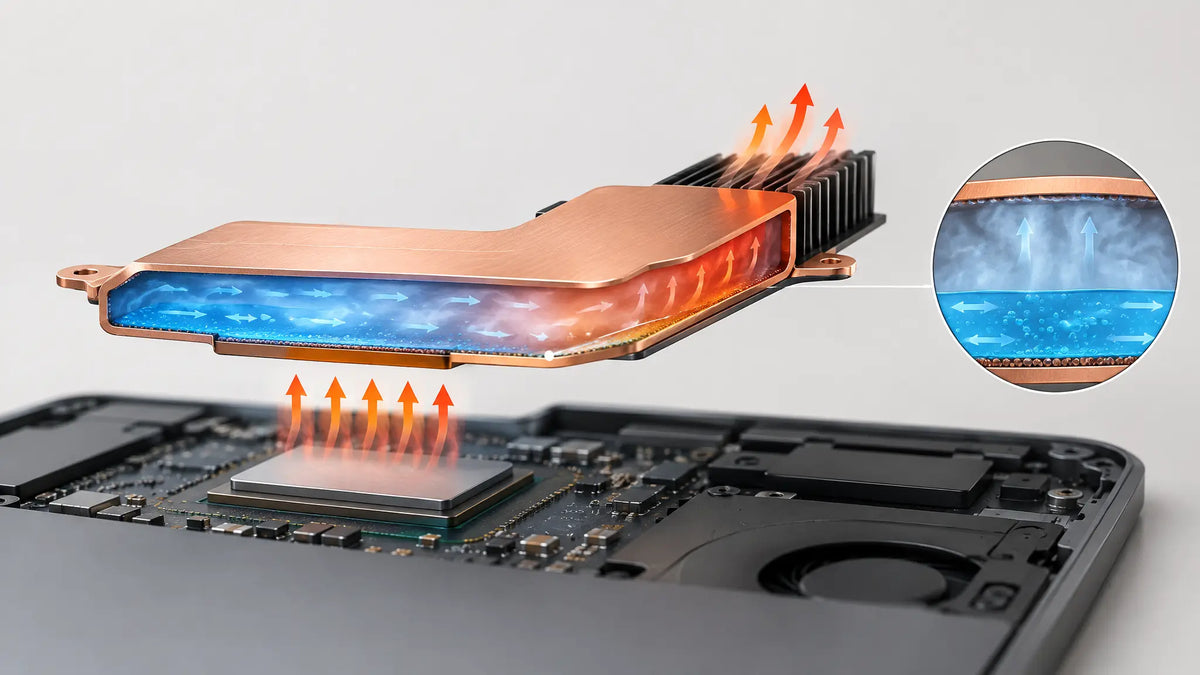
Every computer needs a way to move heat away from its processors to prevent temperature spikes that can throttle performance and potentially damage your hardware. That’s especially important for mini PCs, which pack high-performance components into a compact space.
Vapour chamber cooling is one method that mini PCs and other devices use to distribute heat. In this guide, we take a closer look at vapour chamber cooling, how it works and why it matters so much.
Key Takeaways
• Vapour chamber cooling uses a sealed chamber with fluid inside to transfer heat away from the processors in mini PCs, smartphones and other devices.
• It helps keep your processor within its normal operating temperature range, preventing thermal throttling and helping to minimise fan noise.
• It’s more efficient than heat pipe cooling at spreading heat and preventing hotspots, and is especially worthwhile for sustained, intensive use such as gaming and creative work.
What Is Vapour Chamber Cooling?
Vapour chamber cooling is a technique for transferring and spreading heat in computers, smartphones and other devices. It relies on a fluid that’s liquid when cool but quickly vaporises when heated. That change from liquid to gas allows the fluid to carry heat away from your device’s processor and keep it cool.
Vapour chambers aren’t the most common type of cooling in today’s devices. But because they’re highly efficient at spreading heat and preventing hotspots, they’re often used in high-performance devices that generate a lot of heat, or in compact devices that don’t have room for a traditional heatsink and fans.
How Vapour Chamber Cooling Works
A vapour chamber consists of a sealed metal enclosure containing a small amount of working fluid, a wick structure and support pillars that help stop the chamber from collapsing under pressure. The air is drawn out of the chamber before it’s sealed, allowing the fluid to operate at a suitable temperature and pressure.
When a processor heats the evaporator area of the chamber, the working fluid absorbs the heat and evaporates. The resulting vapour moves towards cooler areas inside the chamber, where it condenses and releases its latent heat. That heat passes through the chamber wall to the heatsink or cooling fins, which transfer it to the surrounding air.
The wick then returns the condensed liquid to the heated area through capillary action, and the cycle repeats. This process spreads heat across a larger surface, helping to reduce localised hotspots. The vapour chamber itself doesn’t get rid of heat; the rest of the cooling system must ultimately release it into the environment.
Vapour Chamber vs. Heat Pipes
Vapour chambers work on the same principle as heat pipes, which are far more common in today’s devices: they vaporise and condense a liquid to transfer heat. So it’s worth looking at the difference between these two cooling approaches, and why one might be chosen over the other. For a full side-by-side, see our vapour chamber vs. heat pipe comparison.
2D Heat Spreading vs. 1D Heat Transport
The biggest difference between vapour chambers and heat pipes lies in how they move heat. A vapour chamber lets heat spread sideways across the chamber in two dimensions, while a heat pipe moves heat through a sealed tube in one dimension.
This has a significant effect on heat transfer efficiency and on how hotspots form. The 2D spreading action of a vapour chamber lets hot vapour travel across a larger area, preventing hotspots around the processor. The 1D transport action of a heat pipe can move heat away from its source quickly, but the heat is channelled along a narrow tube rather than spread over a wide area.
When Heat Pipes Are Still Enough
Heat pipes can be much cheaper to manufacture than vapour chambers, so they’re still the preferred solution in many devices. You’ll find them, for example, in many home computers that don’t have a high-performance GPU.
Because of the cost difference, even devices that use vapour chambers for their most powerful components usually rely on heat pipes for the rest. A high-end gaming PC, for instance, might use a vapour chamber to cool the GPU and heat pipes to cool the CPU and motherboard.
Here’s an overview of how vapour chambers and heat pipes compare:
|
|
Vapour chambers |
Heat pipes |
|
Typical heat transport |
Spread heat laterally across a flat area |
Primarily transport heat along a tube |
|
Hotspot management |
Well suited to spreading localised heat across a wider surface |
Effective at moving heat away from a source along a defined path |
|
Form factor |
Often flat and suitable for low-profile designs |
Typically tubular, although flattened designs are also available |
|
Manufacturing cost |
Often higher, depending on design and production volume |
Often lower for comparable applications |
|
Typical use cases |
Compact systems where heat needs to spread across a broad contact area |
Systems that need to transport heat to a separate heatsink |
Vapour Chamber vs. Liquid Cooling
Efficient as they are, vapour chambers are no match for liquid cooling in devices that generate very large amounts of heat. Liquid cooling uses a pump to push cool liquid towards a heat source actively, then circulates the heated liquid to a radiator to get rid of the heat.
A key drawback of liquid cooling is that it needs a pump, which adds complexity. Pumps also have moving parts that can fail over time and cause your device to overheat.
Liquid cooling systems also take up considerably more space than vapour chambers. In addition to a pump and a radiator, both fairly bulky, they need tubing to carry liquid back and forth between the heat source and the radiator. That makes them unsuitable for space-constrained devices such as mini PCs and smartphones. Mini PCs that need advanced cooling typically combine a vapour chamber, which spreads the heat, with a fan, which removes it.
How Vapour Chamber Cooling Affects Performance
Ultimately, a vapour chamber aims to keep your hardware cool so it can run at maximum efficiency. So it’s important to understand exactly how it affects your device’s performance.
Can It Help Prevent Thermal Throttling?
Thermal throttling happens when a processor reduces its clock speed or power consumption to manage excessive temperatures. By spreading heat away from the processor and reducing hotspots, a vapour chamber can help limit temperature-related throttling under sustained workloads.
However, temperature isn’t the only factor that determines processor performance. Power limits, current limits, firmware settings and the nature of the workload also affect how long a processor can maintain its boost clocks. Even with effective cooling, a processor may reduce its clock speed once it reaches its configured power limit.
For this reason, a vapour chamber should be seen as one part of the cooling system, not a guarantee of maximum performance. Sustained clock speeds, temperatures and power consumption under realistic workloads tell you far more than the cooling hardware alone.
Does It Make a Mini PC Quieter?
A vapour chamber can also help keep your computer quieter. When a hotspot develops around the processor, a mini PC’s fans have to spin fast to pull heat away from that localised area. Because a vapour chamber is very effective at spreading heat and preventing hotspots, the fans can run at lower speeds and make less noise.
That said, the speed your device’s fans run at depends on the overall system design. A vapour chamber helps reduce fan noise, but it’s not the only factor at play.
Why Sustained Performance Matters More Than Peak Benchmarks
When comparing cooling systems, it’s important to look at how they perform over time, not just at peak benchmark scores.
During a peak performance test, a processor might generate a huge amount of heat, but the cooling system starts from cold and the temperature is well below the throttling limit. In real-world use, your processor has probably been running for a while already, so the processor, the fluid in the cooling system and the heatsinks are all warm.
That means an under-cooled device might look great in a short burst test, then start thermal throttling after 15 minutes of heavy work. Ultimately, what determines whether a cooling system is right for a device is whether it can keep the processor below its throttling limit under sustained workloads.
What Vapour Chamber Cooling Can’t Fix
Highly efficient as it is, vapour chamber cooling isn’t a one-size-fits-all solution for every device.
Crucially, a vapour chamber only spreads heat; it doesn’t get rid of it. To work properly, it needs somewhere to pass that heat on to, so it can be removed from around the processor for good. If a device is used in a hot environment, heat dissipation becomes less efficient and the internal temperature is likely to be higher, however well the vapour chamber spreads the heat.
A vapour chamber also needs to be large enough to handle the amount of heat the processor produces. If it lacks sufficient capacity, heat will build up and the temperature will eventually climb past the processor’s throttling limit.
Another consideration is that while vapour chambers are good at spreading heat in two dimensions, they’re not as good as heat pipes or liquid cooling at moving heat over long distances. A vapour chamber may therefore be less suitable if heat needs to travel to a radiator or fan that sits a long way from the processor.
Is Vapour Chamber Cooling Worth It for a Mini PC?
Vapour chamber cooling can be well worth it for high-performance mini PCs that regularly run heavy workloads. If you use your mini PC for long gaming sessions, heavy multitasking, creative work or AI inference, a vapour chamber is a good way to keep it cool and below its thermal limit. It’s also at the heart of the V-Cooling™ technology used across the VZMORE mini PC range.
For mini PCs mainly used for light workloads, such as basic office tasks or browsing the web, a vapour chamber may not be necessary.
FAQs
Is vapour chamber cooling better than heat pipes?
Vapour chamber cooling is more efficient than heat pipes at spreading heat and preventing hotspots, thanks to its ability to spread heat in two dimensions. However, vapour chambers are more expensive to manufacture, which adds to the cost of a device.
Does vapour chamber cooling reduce CPU temperatures?
A vapour chamber is very effective at spreading heat away from the CPU and preventing hotspots from forming under heavy workloads. This stops your CPU from overheating during long gaming sessions or intensive multitasking. Importantly, the heat spread by a vapour chamber still has to be removed from the device, usually by cooling fins and a fan, to stop temperatures rising.
Is vapour chamber cooling worth it for everyday use?
A vapour chamber often isn’t necessary for computers with mid-range processors that are mainly used for light workloads. It’s more worthwhile in high-performance devices that run heavy workloads.
Does a vapour chamber work if the PC is mounted vertically?
Some vapour chamber cooling systems can struggle when a PC is mounted vertically, because gravity interferes with the wicking process that returns cooled liquid to the hottest part of the chamber. However, modern vapour chambers use sintered wicks that work reliably even in a vertical position.
How long does a vapour chamber last?
Vapour chambers have no moving parts and are fully sealed, so they typically last as long as, or longer than, the rest of the computer’s hardware.
Can a vapour chamber fail?
Yes, a vapour chamber can fail if the seal that keeps the fluid inside is compromised, or if the chamber itself is physically damaged. However, vapour chamber failures are very rare.
Can you add a vapour chamber to a mini PC that doesn’t have one?
Generally, no. The space around a mini PC’s processor is very tight, and a vapour chamber has to fit perfectly against the processor to cool it effectively.
Does vapour chamber cooling need a fan?
Not necessarily; it depends on the device’s design. Some devices pass heat from a vapour chamber to cooling fins or the outer casing without using fans. Others, such as high-performance mini PCs, use fans to remove the heat spread by the vapour chamber more quickly.

VZMORE is a leading manufacturer of AI Mini PCs. Our systems combine whisper-quiet VC cooling, high performance, and intelligent AI processing power—tailored for demanding applications in home offices, creative workflows, and edge computing. Enjoy free shipping on all orders.
Related Articles

Subscribe to Newsletter
Get the latest news, product updates, and exclusive offers delivered straight to your inbox.